
Palatal Expanders Millersville
Looking for more orthodontic treatment options? Visit our Orthodontics in Millersville, MD page to explore braces, clear aligners, retainers, and other teeth-straightening solutions.
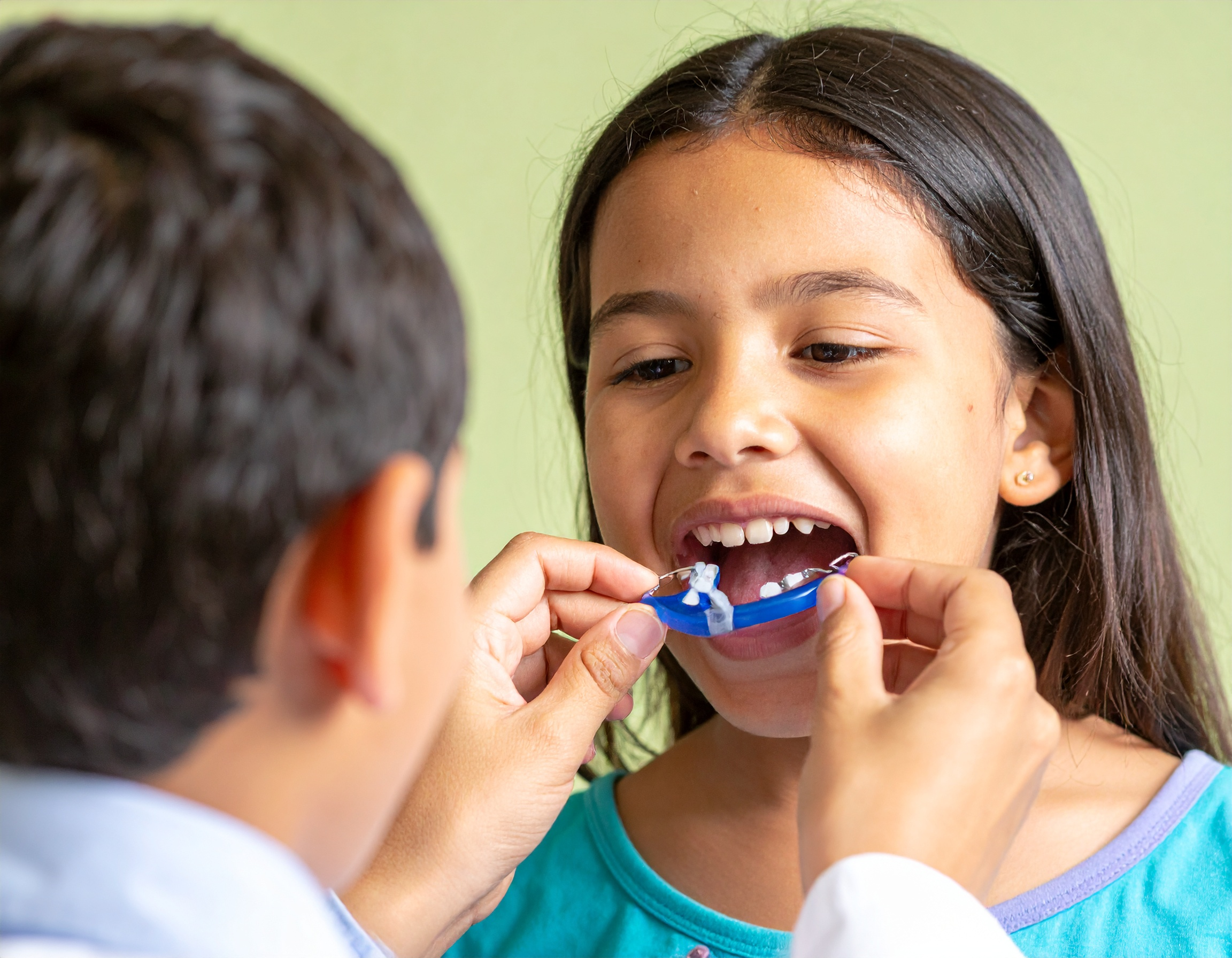
As an orthodontic provider who’s fitted hundreds of palatal expanders over the years, I’ve watched the transformation happen countless times. A child comes in with a narrow upper jaw – teeth crowding, crossbite developing, maybe breathing issues at night. Six months later, after expansion treatment, their smile is wider, their bite is correcting, and often parents report they’re sleeping better too.
Palatal expanders aren’t new technology, but they’re one of the most effective orthodontic tools we have for growing children. By gently widening the upper jaw during the growth years, we can solve problems that would be much more difficult – sometimes requiring surgery – to fix in adulthood. The key is timing. Use an expander at the right age, and you’re working with the body’s natural growth. Wait too long, and you miss the window.
Here’s what many parents don’t realize: a narrow upper jaw doesn’t just affect tooth alignment. It can impact breathing, sleep quality, facial development, and even contribute to chronic mouth breathing. Expansion addresses the root cause rather than just moving teeth around in a too-small space.
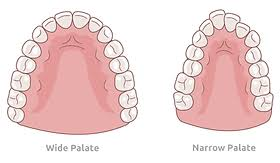
Why Children Need Palatal Expanders
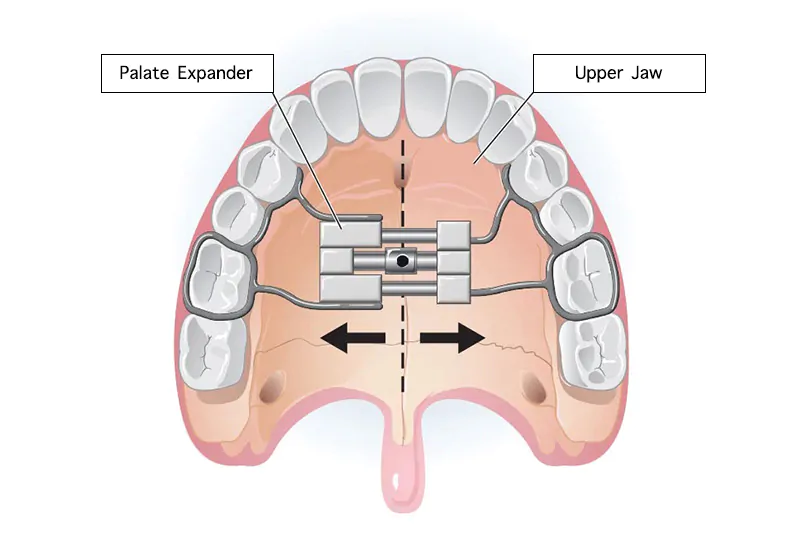
The upper jaw (maxilla) consists of two bones that fuse together during adolescence. In young children, these bones are still connected by a flexible suture in the middle of the palate. A palatal expander applies gentle outward pressure on this suture, gradually widening the jaw.
Crossbite – This is the most common reason we recommend expanders. When the upper jaw is too narrow, upper teeth bite inside the lower teeth instead of outside them. This isn’t just cosmetic – crossbites cause uneven tooth wear, jaw shifting to compensate, and can lead to TMJ problems later. Correcting crossbite early prevents these issues.
Severe crowding – If a child’s jaw is too narrow to accommodate all their permanent teeth, we have two options: extract healthy teeth to make room, or expand the jaw to create natural space. Expansion is almost always the better choice. We’re creating room by using the body’s own growth potential rather than removing permanent teeth.
Impacted teeth – Sometimes permanent teeth can’t erupt properly because there’s no room. Canines are particularly prone to impaction. Expanding the upper jaw creates space for these teeth to come in naturally, avoiding surgical exposure later.
Breathing and airway issues – A narrow upper jaw often means a narrow nasal passage. Kids with this anatomy tend to be mouth breathers, which affects sleep quality, oxygen intake, and facial development. Expansion literally widens the nasal floor, improving airflow. We’ve had parents report that chronic stuffy noses resolved after expansion, and kids who were mouth breathers started breathing through their noses.
Preparing for comprehensive orthodontics – Even if a child will need braces later, expansion done early (ages 7-10) creates proper jaw width first. Then when braces go on, we’re aligning teeth within properly sized jaws rather than trying to fit too many teeth in too small a space. This often shortens the time braces are needed and improves final results.
According to the American Association of Orthodontists, early intervention with appliances like expanders can prevent more serious problems from developing and may reduce the need for more invasive treatment later.
Types of Palatal Expanders
We offer several types of expanders, and which one we recommend depends on the child’s age, the amount of expansion needed, and the specific issue we’re correcting.
Rapid Palatal Expander (RPE)
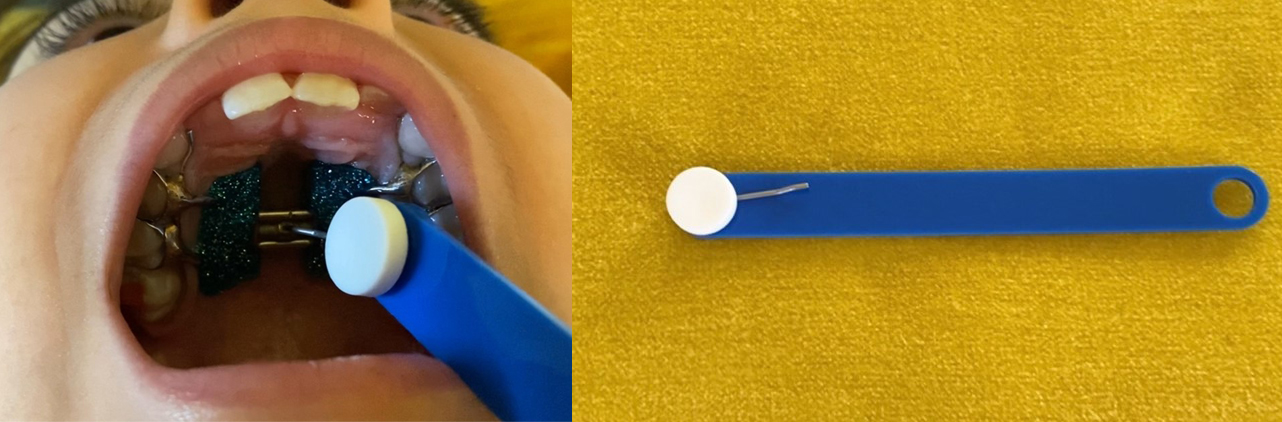
This is the most common type. It’s a fixed appliance – bonded to the upper molars with bands – that has a screw mechanism in the center. Parents turn the screw with a small key according to our schedule (typically once or twice daily). Each turn creates a tiny amount of widening.
Best for: Kids ages 7-14, significant expansion needed (4-8mm), crossbites, severe crowding.
Slow Expanders
These work on the same principle as rapid expanders but are activated less frequently – maybe once or twice per week instead of daily. The expansion happens more gradually.
Best for: Kids who need moderate expansion, those with TMJ sensitivity, cases where we want very controlled expansion.
Bonded Expanders
These are cemented directly to the palate with acrylic coverage over some or all of the upper teeth. The acrylic prevents the back teeth from fully touching together while expansion happens.
Best for: Kids with certain bite problems that need to be managed during expansion, cases where we need to prevent bite interference during the process.
Removable Expanders
These look similar to retainers with a screw mechanism built in. The child can take them out for eating and brushing but wears them the rest of the time.
Best for: Very mild expansion needs, older teens or young adults where the palatal suture is starting to fuse, patients who can’t tolerate fixed appliances.
Limitation: Less effective than fixed expanders because the suture isn’t being directly separated.
Comparison of Expander Types
| Type | Fixed/Removable | Expansion Speed | Best Age | Amount of Expansion | Compliance Needed |
|---|---|---|---|---|---|
| Rapid Palatal Expander (RPE) | Fixed | Fast (2-4 weeks) | 7-14 years | Significant (4-8mm) | Low (parent-controlled) |
| Slow Expander | Fixed | Gradual (months) | 7-14 years | Moderate (3-6mm) | Low (parent-controlled) |
| Bonded Expander | Fixed | Fast to moderate | 7-14 years | Significant (4-8mm) | Low (parent-controlled) |
| Removable Expander | Removable | Very slow | 12+ years | Limited (2-4mm) | High (child must wear) |
Expanders for Teens and Adults
While palatal expansion works best in younger children, we do have options for teens and adults whose jaws have already fused.
For teens (14-16 years old): The palatal suture starts to fuse around age 14-16 in most people. We can still attempt expansion in this age group, but it may require more force, take longer, and achieve less skeletal expansion. Sometimes we use surgically-assisted expanders (SARPE) where an oral surgeon makes small cuts in the palatal suture before we activate the expander.
For adults: True skeletal expansion isn’t possible once the suture is fully fused (usually by late teens/early 20s). However, we have alternatives: orthodontic camouflage (using braces to tip teeth outward), SARPE (surgically-assisted expansion), or jaw surgery for severe cases.
The reality is that expansion done at age 8 is straightforward. The same expansion attempted at age 25 requires surgery. That’s why we emphasize early evaluation – seeing kids around age 7 lets us catch these issues when they’re easiest to treat.
The Expansion Process: What to Expect
Initial Consultation: We examine the child’s bite, take x-rays, photos, and digital scans.
Getting the Expander: Custom-made for the child’s mouth. Takes about an hour to place. We teach parents how to use the activation key.
Activation Phase (2-4 weeks): Parents turn the expander once or twice daily. Each turn equals about 0.25mm of expansion. Kids feel pressure but it shouldn’t hurt.
Stabilization Phase (3-6 months): We stop turning but leave the expander in place. This lets new bone fill in the expanded suture. The gap between front teeth starts closing naturally.
Removal: After several months, we remove the expander. Total process: 6-9 months.
What About the Gap? The gap between front teeth is proof expansion is working. Once we stop turning, the gap closes naturally as front teeth drift back together.
Expansion Timeline
| Phase | Duration | What’s Happening |
|---|---|---|
| Active Expansion | 2-4 weeks | Daily turning, jaw widening, gap appears between front teeth |
| Early Stabilization | 2-3 months | Expander stays in, no more turning, new bone starts forming |
| Late Stabilization | 2-3 months | Continued bone formation, gap between front teeth begins closing |
| Post-Removal | Ongoing | Retainer or braces may be needed to maintain expansion |
Life with a Palatal Expander
Eating: Avoid super sticky foods (caramel, taffy, gum) and hard foods requiring biting directly (whole apples, carrots). Pizza is fine if cut into smaller pieces.
Speech: Talking sounds different initially. Most kids adapt within a week. Reading aloud helps speed adjustment.
Oral hygiene: Rinse vigorously after eating, use a water flosser, brush carefully around bands and wires.
Discomfort: Turning creates pressure but shouldn’t cause pain. Kids might feel tightness in teeth, palate, nose, or under eyes. Pressure fades within minutes to hours.
The activation key: Insert key in hole, push backward toward throat until it stops, remove key. You’ll see the next hole appear confirming the turn worked.
Cost Considerations for Palatal Expanders
Palatal expanders typically cost $1,500-$3,000 as a standalone treatment. The exact price depends on the type of expander and complexity.
What’s included: Initial consultation, x-rays/scans, custom fabrication, placement appointment, adjustment checkups, removal, turning key and instructions.
Insurance coverage: Most dental insurance with orthodontic benefits covers expanders at 50% up to the lifetime maximum (usually $1,500-$2,000).
Payment options: Insurance filing, monthly payment plans, CareCredit, FSA/HSA accounts.
While $2,000-$3,000 seems expensive, expansion done at the right age often prevents tooth extractions, reduces time in braces, and avoids potential jaw surgery later.
Why Choose Smile Rx for Palatal Expansion
We’ve successfully treated hundreds of expansion cases for kids from Millersville, Odenton, Crofton, Pasadena, Annapolis, Gambrills, Crownsville, Glen Burnie, and Severna Park.
Early evaluation focus – We see kids as early as age 7 for orthodontic screening.
Experience with all expander types – Dr. Khan has extensive training in growth modification.
Comprehensive approach – We consider how jaw width affects breathing, sleep, and facial development.
Parent education – We teach parents exactly how to turn the expander and what to expect.
Gentle monitoring – Regular checkups during expansion to ensure proper tracking.
Is Your Child a Candidate?
Good candidates: Ages 7-14 (earlier is better), crossbite/crowding/narrow palate, healthy teeth and gums, parents committed to turning schedule.
Ready to Create Space for a Healthier Smile?

If your child has a crossbite, crowding, or a narrow upper jaw, palatal expansion might be the answer. Early treatment during the growth years can prevent more complex treatment later.
We serve families throughout Anne Arundel County – Millersville, Odenton, Crofton, Pasadena, Annapolis, Gambrills, Crownsville, Glen Burnie, and Severna Park. We welcome children as young as 7 for orthodontic evaluations.
Start with a free consultation. We’ll examine your child’s jaw and bite development, discuss whether expansion is recommended, and explain the complete treatment process with exact costs and timeline.
Looking for more orthodontic treatment options? Visit our Orthodontics in Millersville, MD page to explore braces, clear aligners, retainers, and other solutions for creating beautiful, healthy smiles.
Frequently Asked Questions About Palatal Expanders

What's the ideal age for getting a palatal expander?
The best age for palatal expansion is typically between 7 and 10 years old, before the palatal suture begins to fuse. At this age, the bone is still growing and the two halves of the upper jaw are connected by flexible cartilage, making expansion straightforward and comfortable. We can successfully expand jaws up to about age 14-15 in many cases, but treatment becomes more difficult as kids get older. After mid-adolescence, the suture fuses and skeletal expansion requires surgical assistance. That’s why the American Association of Orthodontists recommends orthodontic evaluations by age 7 – to catch these issues during the optimal treatment window.
Are there alternatives to using a palatal expander?
For true skeletal expansion in children with narrow upper jaws, there’s really no alternative that works as well as an expander during the growth years. However, depending on the specific problem, we might consider: orthodontic treatment that tips teeth outward without widening the bone (orthodontic camouflage), extracting teeth to create space instead of expanding (though we avoid this when possible), or for adults, surgically-assisted expansion or jaw surgery. For mild cases in older teens, clear aligners or braces might create enough space by moving teeth within the existing jaw width. But for significant narrowness or crossbites in growing children, expansion is the gold standard treatment.
Why are so many children needing palatal expanders now?
You’re not imagining it – we are seeing more narrow upper jaws than in previous generations. Several factors contribute: softer modern diets require less chewing, which means jaw bones don’t develop as robustly; chronic mouth breathing (often from allergies or enlarged tonsils) can affect facial growth; earlier detection means we’re catching issues that might have been missed before; and genetics plays a role. The good news is that we have effective treatment. Expanders are becoming more common because we’ve gotten better at identifying kids who need them early, when treatment works best.
How long does a child wear a palatal expander?
The typical timeline is 6-9 months total. The active expansion phase where parents turn the key daily lasts 2-4 weeks usually. Then the expander stays in place for another 3-6 months while new bone fills in the expanded suture – this is called the retention or stabilization phase. We need this retention time because the bone takes months to properly form and harden in the expanded space. If we removed the expander too early, the jaw would relapse back to its original width. After removal, some kids go straight into braces while others have a waiting period to let more permanent teeth come in.
Can adults get palatal expanders or is it only for kids?
Adults can expand their upper jaws, but it’s much more complicated than for children. Once the palatal suture fuses (usually by late teens to early 20s), skeletal expansion requires surgically-assisted expansion – an oral surgeon makes cuts in the fused suture, then we use an expander to widen the jaw. This is more invasive, more expensive, and has a longer recovery than expansion in children. For mild expansion needs in young adults where the suture is just starting to fuse, we might attempt expansion with an appliance, but results are less predictable. The bottom line: expansion is possible in adults but requires surgery. This is why early treatment in childhood is so valuable – we can avoid surgical procedures later.
What are the disadvantages of palatal expanders?
The main downsides are: temporary gap between front teeth which worries parents (though it closes naturally), speech changes for the first week or two while kids adjust, extra cleaning required around the appliance, difficulty eating certain sticky or hard foods during treatment, pressure or discomfort when the appliance is turned (though this usually fades quickly), and the daily commitment of turning the key on schedule. Some kids experience temporary sore spots where the bands contact gums. Very rarely, we see complications like the expander coming loose or becoming embedded in tissue if oral hygiene is poor. However, these disadvantages are temporary and minor compared to the benefits of properly expanding a narrow jaw.
How much do palatal expanders typically cost for children?
Palatal expanders generally cost between $1,500 and $3,000 as a standalone treatment. The exact price depends on the type of expander used and case complexity. Most dental insurance plans with orthodontic benefits cover expanders at 50% up to the lifetime orthodontic maximum (typically $1,500-$2,000). If expansion is part of comprehensive orthodontic treatment (expansion followed by braces), the expander cost is usually included in the total treatment fee rather than charged separately. We offer payment plans to spread the cost over the treatment time. While it seems expensive, expansion done at the right age often prevents the need for tooth extractions and can reduce overall time in braces later.
Can a child eat pizza while wearing a palatal expander?
Yes, kids can eat pizza with an expander, but they need to cut it into smaller pieces rather than biting directly into a whole slice. The expander itself doesn’t prevent eating pizza – it’s the bands cemented to the molars that can come loose if you bite into hard or chewy foods with too much force. Cut the pizza into bite-sized pieces, chew with molars (not front teeth), and avoid super thick or tough crust. Avoid putting extra sticky or hard toppings directly on the bands. Most kids adapt quickly and learn what works. The first few days after getting the expander, stick with softer foods until you get used to eating with it.
How painful is a palatal expander for children?
Most kids tolerate expanders well with minimal pain. The placement appointment itself doesn’t hurt – we’re just cementing bands to teeth, which is painless. When parents turn the activation key, kids feel pressure in their teeth, palate, and sometimes around their nose or under their eyes (because we’re separating the bones of the upper jaw). This pressure typically lasts a few minutes to a few hours after turning. The first few turns feel the weirdest because it’s a new sensation. After a week or so, most kids barely react to the turning. If needed, over-the-counter pain reliever given 30 minutes before turning can help. The discomfort is temporary and manageable – definitely not the kind of pain that prevents eating or sleeping.
Is 10 years old too late for a palatal expander?
No, 10 years old is actually still a great age for expansion – you’re right in the sweet spot. The ideal age range is 7-14, and 10 falls perfectly in the middle. At 10, the palatal suture is still flexible and hasn’t begun fusing, so skeletal expansion works well. You haven’t missed the window at all. We successfully expand jaws in kids up through early teens. What you want to avoid is waiting until mid-to-late teens when the suture starts fusing. If your child is 10 and needs expansion, now is an excellent time to do it before more permanent teeth come in and before the growth window starts closing.
What foods are off-limits with a palatal expander?
Avoid sticky foods that can pull bands loose: caramel, taffy, gummy candy, gum, Starburst, Now and Later candies, Tootsie Rolls. Avoid hard foods that require biting forcefully: whole apples or carrots (cut them up instead), hard pretzels, nuts, hard candy, ice. Be careful with chewy foods: bagels, hard bread crust, tough meat (cut into small pieces). Pizza, burgers, sandwiches are fine if you cut them into smaller pieces rather than biting into them. Soft foods like pasta, mashed potatoes, yogurt, eggs, soft fruits, cooked vegetables are all fine. The main rule: if you have to bite hard or it’s super sticky, either avoid it or modify how you eat it.
At what point are teeth beyond fixing with orthodontics?
Teeth are almost never beyond fixing – age alone doesn’t disqualify someone from orthodontic treatment. We successfully treat patients in their 60s and 70s. What matters is the health of teeth and supporting structures. You can’t do orthodontics if: gums and bone are too damaged from periodontal disease (not enough support to move teeth), teeth are so decayed they can’t support brackets, or medical conditions make treatment unsafe. But chronological age itself isn’t a barrier. Adults do have some limitations compared to kids – we can’t do skeletal expansion without surgery, treatment takes a bit longer because bones are denser, and some complex jaw discrepancies might require surgery. But the teeth themselves can be moved at any age if they’re healthy.
How do I know if my child's crossbite needs expansion treatment?
Crossbites should be evaluated by an orthodontist to determine if expansion is needed. Signs your child might need expansion: upper teeth bite inside lower teeth on one or both sides, your child shifts their jaw to one side when biting, the upper arch looks noticeably narrower than the lower arch, crowding is severe with no room for permanent teeth, your child is a chronic mouth breather or has breathing difficulties. During evaluation, we measure the upper and lower arch widths, check how teeth fit together, take x-rays to see jaw structure, and assess growth and development. Not every crossbite requires expansion – very mild cases might be managed with braces alone. But moderate to severe crossbites and significant jaw narrowness usually benefit from expansion, especially when done during the growth years.
Will my child need braces after palatal expansion?
Many kids who need expansion will also need braces, but not always. Expansion creates proper jaw width and corrects crossbites, but it doesn’t usually align all the teeth perfectly or correct every bite issue. If a child only has a crossbite and the expander fixes it completely, they might not need braces. However, if there’s crowding, rotation, spacing, or other alignment issues, braces will likely be recommended after expansion. The good news: expanding first often shortens the time braces are needed and improves the final result because we’re working with properly sized jaws. We create a comprehensive treatment plan upfront, so you’ll know from the beginning whether braces will be part of the plan.
Can a palatal expander fix an overbite or is it only for narrow jaws?
Palatal expanders primarily address narrow upper jaws and crossbites – they widen the upper arch. They don’t directly correct overbites (where upper front teeth stick out too far over lower teeth). However, in some cases, expansion can indirectly help with bite issues. If a child has both a narrow upper jaw and an overbite, we might expand first to create proper jaw width, then address the overbite with braces or other appliances. Sometimes functional appliances can be used along with or after expansion to help with overbite correction. The bottom line: expanders are specifically for widening the jaw, but they’re often part of a comprehensive treatment plan that addresses multiple orthodontic issues including overbites.
Ready for Your Child's Free Expansion Consultation?
We’ll examine your child’s bite and jaw development, explain whether expansion is recommended, and give you exact costs and timeline. No pressure, no obligation.